Friday, 3 May 2013

Art Informel - 1940-1950

Art Informel is a French style of abstract painting in the 1940s and 1950s. It is often considered to be the European offshoot of abstract expressionism. Sometimes referred also to as Tashism, Art Autre or Lyrical Abstraction, it was a type of abstraction in which form became subservient to the expressive impulses of the artist, and it was thus diametrically opposed to the cool rationalism of geometric abstraction. Term was coined in 1950 by the French critic Michel Tapi, primarily in relation to the work of Wols. Here are some of his pictures which marked the beginning of Art Informel movement:


Following the lead of Surrealist automatism, current in Surrealism, Art informel pictures were executed spontaneously and often at speed so as to give vent to the subconscious of the artist. Though embodying a wide range of approaches to abstraction, the brushwork in such works is generally gestural or calligraphic. Sometimes there is an emphasis on the texture or tactile quality of the paint, leading to a variant of Art informel referred to as Matter Painting.
   Antecedents of this style were Vasily Kandinsky, Paul Klee and Jean Dubuffet and particularly Andre Masson. In its more precise historical sense its pioneers were artists based in Paris, such as Jean Fautrier and Hans Hartung. Hartung in particular was producing paintings with many of the features of Art informel by the mid-1930s. 

Thursday, 2 May 2013

Kinetic art - 1930-1960


File:Soto Sphere.jpg

Kinetic art is art that contains moving parts or depends on motion for its effect. The moving parts are generally powered by wind, a motor or the observer. Kinetic art encompasses a wide variety of overlapping techniques and styles.
Kinetic drawing.

   Kinetic drawing makes use of the critical balance and creates 3D drawings from various materials. Kinetic means that the object holds energy, kinetic drawings usually are critical in their stability and are eager to find a more stable position, through gravity. From there they are built up again, better and stronger and with a repetition of this process a beauty of its own starts to grow by natural forces.
   A variation of kinetic art in the realm of painting is ModulArtwhere smaller modular elements allow a larger painting to be in flux, though not continuously but at the will of its creator, owner, or user. However, the painting stays in motion, offering alternative views and alternative interpretations.

Selected kinetic of artists

Wednesday, 1 May 2013

Art Deco - 1925-1940

Art Deco is a decorative and architectural style of the period 1925-1940, characterized by geometric designs, bold colors, and the use of plastic and glass. This movement first appeared in France during the 1920s, flourished internationally during the 30s and 40s, then waned in the post-World War II era. It is an eclectic style that combines traditional craft motifs with Machine Age imagery and materials. Its products included both individually crafted luxury items and mass-produced wares, but, in either case, the intention was to create a sleek and antitraditional elegance that symbolized wealth and sophistication.
  Influenced by Art Nouveau, Bauhaus, Cubist, Native American, and Egyptian sources, the distinguishing features of the style are simple, clean shapes, often with a streamlined look; ornament that is geometric or stylized from representational forms; and unusually varied, often expensive materials, which frequently include man-made substances (plastics, especially bakelite; vita-glass; and ferroconcrete) in addition to natural ones (silver, ivory and rock crystal). Typical motifs included stylized animals, foliage, nude female figures, and sun rays. The name derives from the "Exposition Internationale des Arts Dcoratifs et Industriels Modernes" in Paris in 1925, where new ideas in applied arts were demonstrated. Here are some of them:


Speaking about painting Vadym Maller was the first artist to be awarded a gold medal in this exhibition. Here is one of his pictures in Art Deco style:

By the way, the famouse Christ the Redeemer in Rio de Janeiro is also refered to this art movement. This is the largest Art Deco statue in the world.

Here are some of representatives: Cassandre, Tamara de Lempicka, Andre Mare, George Barbier, Vadym Meller.  

Wednesday, 3 April 2013

Pop Art - 1955-1975

Pop art is an art movement that emerged in the mid 1950s in Britain and in the late 1950s in the United States. Pop art presented a challenge to traditions of fine art by including imagery from popular culture such as advertising, news, etc. In Pop art, material is sometimes visually removed from its known context, isolated, and/or combined with unrelated material. The concept of pop art refers not as much to the art itself as to the attitudes that led to it.
 
Andy Warhol, Campbell's Tomato Juice Box, 1964.

 Pop art employs aspects of mass culture, such as advertising, comic books and mundane cultural objects. It is widely interpreted as a reaction to the then-dominant ideas of abstract expressionism, as well as an expansion upon them. And due to its utilization of found objects and images it is similar to Dada. Pop art is aimed to employ images of popular as opposed to elitist culture in art, emphasizing the banal or kitschy elements of any given culture, most often through the use of irony.It is also associated with the artists' use of mechanical means of reproduction or rendering techniques.The subject matter is far from traditional "high art" themes of morality, mythology, and classic history; rather, Pop artists celebrated commonplace objects and people of everyday life, in this way seeking to elevate popular culture to the level of fine art. Perhaps owing to the incorporation of commercial images, Pop art has become one of the most recognizable styles of modern art.

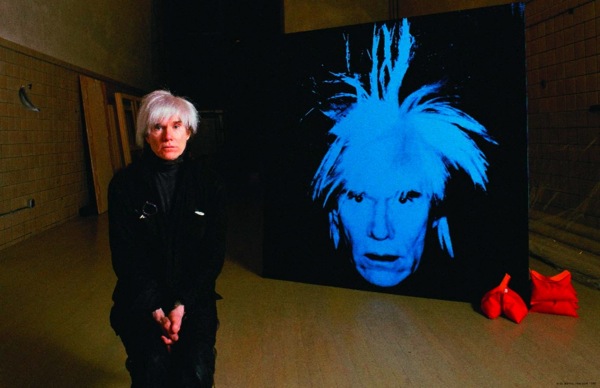
Andy Warhol


Andy Warhol (August 6, 1928 – February 22, 1987) was an American artist who was a leading figure in the visual art movement known as pop art. His works explore the relationship between artistic expression, celebrity culture and advertisement that flourished by the 1960s. After a successful career as a commercial illustrator, Warhol became a renowned and sometimes controversial artist. The Andy Warhol Museum in his native city,Pittsburgh, Pennsylvania, holds an extensive permanent collection of art and archives. It is the largest museum in the United States dedicated to a single artist.

Warhol's art encompassed many forms of media, including hand drawing, painting, printmaking, photography, silk screening, sculpture, film, and music. He was also a pioneer in computer-generated art using Amiga computers that were introduced in 1984, two years before his death. He foundedInterview Magazine and was the author of numerous books, including The Philosophy of Andy Warhol and Popism: The Warhol Sixties. He is also notable as a gay man who lived openly as such before the gay liberation movement. His studio, The Factory, was a famous gathering place that brought together distinguished intellectuals, drag queens, playwrights, Bohemian street people, Hollywood celebrities, and wealthy patrons.

Warhol has been the subject of numerous retrospective exhibitions, books, and feature and documentary films. He coined the widely used expression "15 minutes of fame". Many of his creations are very collectible and highly valuable. The highest price ever paid for a Warhol painting is US$100 million for a 1963 canvas titled Eight Elvises. The private transaction was reported in a 2009 article in The Economist, which described Warhol as the "bellwether of the art market".Warhol's works include some of the most expensive paintings ever sold.

Roy Lichtenstein: Drowning Girl


Drowning Girl is a bright example of Roy Lichtenstein's comic style. It was derived from the lead story in DC Comics' Secret Hearts #83. Drowning girl is a large size picture, which is notable for its content, what is more it is colorfully and texturally rich. The girl's head is enormously large. It is located in the foreground of the picture, surrounded by threatening waves. The girl is sinking under the water and a speech balloon brilliantly conveys her thoughts. The girl would rather drown than call for Brad to come help her. This phrase is humorous and tragic as well. The colors used in the painting work together.  Benday dots, a form of coloring, which was also frequently used in comic books, can also be found in this work. The use of such strong colors and textures shows the melodrama of the situation. For this work the artist used oil and Magna paint. The picture makes you feel hopeless and anxious. The title of the picture coincides with the experienced emotions. Drowning Girl is considered to be an excellent example of Pop Art.

Tuesday, 2 April 2013

Op Art - 1950-1970

Op art, also known as optical art, is a style of visual art that makes use of optical illusions. "Optical art is a method of painting concerning the interaction between illusion and picture plane, between understanding and seeing." Op art works are abstract, with many of the better known pieces made in red and yellow . When the viewer looks at them, the impression is given of movement, hidden images, flashing and vibration, patterns, or alternatively, of swelling or warping.
Movement in Squares, by Bridget Riley 1961

Op art is a perceptual experience related to how vision functions. It is a dynamic visual art, stemming from a discordant figure-ground relationship that causes the two planes to be in a tense and contradictory juxtaposition. Op art is created in two primary ways. The first, and best known method, is the creation of effects through the use of pattern and line. Another reaction that occurs is that the lines create after- images of certain colors due to how the retina receives and processes light. As Goethe demonstrates in his treatise Theory of Colours, at the edge where light and dark meet, color arises because lightness and darkness are the two central properties in the creation of color.