Sunday, 30 June 2013

Constructivism - 1917-1924

Constructivism was the last and most influential modern art movement to flourish in Russia in the 20th century. It evolved just as the Bolsheviks came to power in the October Revolution of 1917, and initially it acted as a lightning rod for the hopes and ideas of many of the most advanced Russian artists who supported the revolution's goals. It borrowed ideas from Cubism, Suprematism and Futurism, but at its heart was an entirely new approach to making objects, one which sought to abolish the traditional artistic concern with composition, and replace it with 'construction.' Constructivism called for a careful technical analysis of modern materials, and it was hoped that this investigation would eventually yield ideas that could be put to use in mass production, serving the ends of a modern, Communist society. Ultimately, however, the movement foundered in trying to make the transition from the artist's studio to the factory. Some continued to insist on the value of abstract, analytical work, and the value of art per se; these artists had a major impact on spreading Constructivism throughout Europe. Others, meanwhile, pushed on to a new but short-lived and disappointing phase known as Productivism, in which artists worked in industry. Russian Constructivism was in decline by the mid 1920s, partly a victim of the Bolshevik regime's increasing hostility to avant-garde art. But it would continue to be an inspiration for artists in the West, sustaining a movement called International Constructivism which flourished in Germany in the 1920s, and whose legacy endured into the 1950s.

Key Ideas:
Constructivists proposed to replace art's traditional concern with composition with a focus on construction. Objects were to be created not in order to express beauty, or the artist's outlook, or to represent the world, but to carry out a fundamental analysis of the materials and forms of art, one which might lead to the design of functional objects. For many Constructivists, this entailed an ethic of "truth to materials," the belief that materials should be employed only in accordance with their capacities, and in such a way that demonstrated the uses to which they could be put.
   Constructivist art often aimed to demonstrate how materials behaved - to ask, for instance, what different properties had materials such as wood, glass, and metal. The form an artwork would take would be dictated by its materials (not the other way around, as is the case in traditional art forms, in which the artist 'transforms' base materials into something very different and beautiful). For some, these inquiries were a means to an end, the goal being the translation of ideas and designs into mass production; for others it was an end in itself, a new and archetypal modern style expressing the dynamism of modern life.
   The seed of Constructivism was a desire to express the experience of modern life - its dynamism, its new and disorientating qualities of space and time. But also crucial was the desire to develop a new form of art more appropriate to the democratic and modernizing goals of the Russian Revolution. Constructivists were to be constructors of a new society - cultural workers on a par with scientists in their search for solutions to modern problems.

The sailor self-portrait
Key artists:   Vladimir Tatlin,  El Lissitzky, Laszlo Moholy-Nagy

Thursday, 20 June 2013

Bauhaus - 1920-1945


Staatliches Bauhaus commonly known simply as Bauhaus, was a school in Germany that combined crafts and the fine arts, and was famous for the approach to design that it publicized and taught. It operated from 1919 to 1933. Nonetheless it was founded with the idea of creating a "total" work of art in which all arts, including architecture, would eventually be brought together. The Bauhaus style became one of the most influential currents in Modernist architecture and modern design.
   The paradox of the early Bauhaus was that, although its manifesto proclaimed that the ultimate aim of all creative activity was building, the school did not offer classes in architecture until 1927. The most important influence on Bauhaus was modernism. The Bauhaus was founded at a time when the German zeitgeist had turned from emotional Expressionism to the matter-of-fact New Objectivity. An entire group of working architects, including Erich Mendelsohn, Bruno Taut and Hans Poelzig, turned away from fanciful experimentation, and turned toward rational, functional, sometimes standardized building.
   Erich Mendelsohn (21 March 1887 – 15 September 1953) was a Jewish German architect, known for his expressionist architecture in the 1920s, as well as for developing a dynamic functionalism in his projects for department stores and cinemas. Bruno JuliusFlorian Taut (4 May 1880, Königsberg, Germany – 24 December 1938, Istanbul), was a prolific German architect, urban planner and author active during the Weimar period. Hans Poelzig (30 April 1869 Berlin – 14 June 1936 Berlin) was a German architect, painter and set designer.

Friday, 14 June 2013

Expressionism - 1920-1990

Expressionism emerged simultaneously in various cities across Germany as a response to a widespread anxiety about humanity's increasingly discordant relationship with the world and accompanying lost feelings of authenticity and spirituality. In part a reaction against Impressionism and academic art, Expressionism was inspired most heavily by the Symbolist currents in late nineteenth-century art. Vincent van Gogh, Edvard Munch, and James Ensor proved particularly influential to the Expressionists, encouraging the distortion of form and the deployment of strong colors to convey a variety of anxieties and yearnings. The classic phase of the Expressionist movement lasted from approximately 1905 to 1920 and spread throughout Europe. Its example would later inform Abstract Expressionism, and its influence would be felt throughout the remainder of the century in German art. It was also a critical precursor to the Neo-Expressionist artists of the 1980s.

Key Ideas
The arrival of Expressionism announced new standards in the creation and judgment of art. Art was now meant to come forth from within the artist, rather than from a depiction of the external visual world, and the standard for assessing the quality of a work of art became the character of the artist's feelings rather than an analysis of the composition.
   Expressionist artists often employed swirling, swaying, and exaggeratedly executed brushstrokes in the depiction of their subjects. These techniques were meant to convey the turgid emotional state of the artist reacting to the anxieties of the modern world.
   Through their confrontation with the urban world of the early twentieth century, Expressionist artists developed a powerful mode of social criticism in their serpentine figural renderings and bold colors. Their representations of the modern city included alienated individuals - a psychological by-product of recent urbanization - as well as prostitutes, who were used to comment on capitalism's role in the emotional distancing of individuals within cities.

Nude Dancers

Wednesday, 5 June 2013

Surrealism - 1920-1950

Surrealism is a cultural movement that was founded in 1924 by Andre Breton, and is best known for its visual artworks and writings. Surrealism style uses visual imagery from the subconscious mind to create art without the intention of logical comprehensibility.
Surrealism developed out of the Dada activities during World War I and the most important center of the movement was Paris. From the 1920s onward, the movement spread around the globe, eventually affecting the visual arts, literature, film, and music of many countries and languages, as well as political thought and practice, philosophy, and social theory. Influenced by the psychoanalytical work of Freud and Jung, there are similarities between the Surrealist movement and the Symbolist movement of the late 19th century.

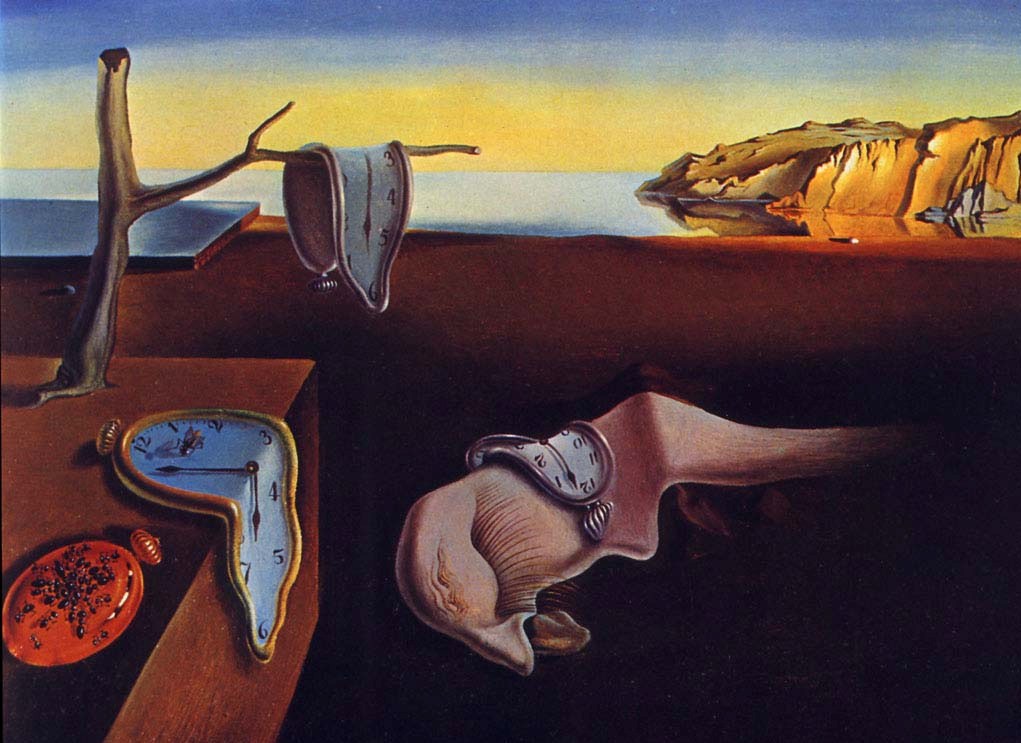
Salvador Dali “The Persistence of Memory”

Surrealist works feature the element of surprise, unexpected juxtapositions and non sequitur; however, many Surrealist artists and writers regard their work as an expression of the philosophical movement first and foremost, with the works being an artefact. Leader André Breton was explicit in his assertion that Surrealism was above all a revolutionary movement.
   The Surrealist movement eventually spread across the globe, and has influenced artistic endeavors from painting and sculpture to pop music and film directing. The greatest known Surrealist artist is the world famous Salvador Dali. Some of the greatest artists of the 20th century became involved in the Surrealist movement, and the group included Giorgio de Chirico, Man Ray, Rene Magritte, Max Ernst, and many others.

Tuesday, 4 June 2013

Salvador Dalí (1)


Salvador Dalí was a prominent Spanish surrealist painter. He was a groundbreaking icon of the Surrealist movement and one of the greatest artists of the 20th century. His work probed the unconscious world of thoughts, dreams and perception in fanciful and nightmarish images influenced by Freud, Cubism, Futurism and metaphysical art. Extraordinarily imaginative, he also sculpted, and contributed to fashion, photography and theater. Dalí's art has been called the epitome of Surrealism.

Woman At the Window (1926)
   Dali sought a change in his life after the meeting with the Surrealists in 1928 in Paris and he knew that this change was not going to occur in Catalonia. However, the Surrealists saw in Dali the future of the movement, because he was armed with an exceptionally rich imaginary baggage. This baggage was a result of his erotic desires for women and his undying interest in the concept of the unconsciousness devised by Sigmund Freud. His precise style enhanced the nightmare effect of his paintings. By 1929 he had become a leader of surrealism.
   As his style matured, Dali’s works became more and more affected by the concept of psychoanalysis devised by Freud. Dali’s works were increasingly shaped into dreamlike illustrations.Dreams consisted of a large segment of his life, because he would take siestas, or midday rests, in which he encounters more and more dreams. He considered the siesta as a state that is achieved at the moment that one forgets about one’s body or in psychoanalysis the state of the unconscious. Yet, his dreamlike style was combined with his sexual desires to give a variety of works with different themes.
The Madonna of Port Lligat (1949)
  In 1934, Dali was accused of showing an interest in the fascist movement led by Hitler and as a result he was kicked out of the Surrealist group in Paris. This did not affect Dali’s art or life because by that time he was well known worldwide for his special style. The main advancement in Dali’s style was the production of religious works. The most famous and also the first of all of his religious works was The Madonna of Port Lligat, in which he arranged the picture around a piece of bread that is visible through a hole in Jesus’ body. Here the influence of Gala was also seen, because he incorporated her into the picture as the Virgin and as angels.

Presentation 1 / Presentation 2 / Film

Salvador Dali: The Persistence of Memory


The composition is horizontal. Due to the size of the picture and its composition Dali could convey a sense of space. Thus in the foreground in the middle of the painting we see the monster or abstract self portrait, and in the left-hand corner is a rectangular table. Against a background of both subjects  melting clocks are placed, that shows the human experience of time and memory. On the background of the landscape are the sea and the rocks, which dlend with a bright-colored sky. Overall the work's colouring are warm colors, where brown (with its hues)predominates. That defines the nearer figures more sharply. But the the composition contains cold and respectful colors. So we can see the combination of arbitrary and hush colours; contrast of light and shade. You can divide the picture space diagonally and see that the rock to the left is in the shadow, and the one to the right is lit by the sun.  Thus the difference between soft and hard objects is evident. So this composition of the surreal landscape is complex,  which sometimes can confuse the eye.

Salvador Dalí (2)

Salvador Domingo Felipe Jacinto Dalí i Domènech, 1st Marqués de Dalí de Pubol known as Salvador Dalí , was a prominent Spanish surrealist painter born in Figueres, Spain.
   Dalí was a skilled draftsman, best known for the striking and bizarre images in hissurrealist work. His painterly skills are often attributed to the influence of Renaissancemasters. His best-known work, The Persistence of Memory, was completed in 1931. Dalí's expansive artistic repertoire included film, sculpture, and photography, in collaboration with a range of artists in a variety of media.
   Dalí attributed his "love of everything that is gilded and excessive, my passion for luxury and my love of oriental clothes" to a self-styled "Arab lineage", claiming that his ancestors were descended from the Moors.
Dalí was highly imaginative, and also enjoyed indulging in unusual and grandiose behavior. His eccentric manner and attention-grabbing public actions sometimes drew more attention than his artwork, to the dismay of those who held his work in high esteem, and to the irritation of his critics.
   Salvador Domingo Felipe Jacinto Dalí i Domènech was born on May 11, 1904 in the town of Figueres, in theEmpordà region, close to the French border in Catalonia, Spain. Dalí's older brother, also named Salvador (born October 12, 1901),had died of gastroenteritis nine months earlier, on August 1, 1903. His father, Salvador Dalí i Cusí, was a middle-class lawyer and notary whose strict disciplinary approach was tempered by his wife, Felipa Domenech Ferrés, who encouraged her son's artistic endeavors. When he was five, Dalí was taken to his brother's grave and told by his parents that he was his brother's reincarnation,a concept which he came to believe.Of his brother, Dalí said, "...[we] resembled each other like two drops of water, but we had different reflections." He "was probably a first version of myself but conceived too much in the absolute." Images of his long-dead brother would reappear embedded in his later works, including Portrait of My Dead Brother (1963).
   Dalí attended drawing school. In 1916, Dalí also discovered modern painting on a summer vacation trip to Cadaqués with the family of Ramon Pichot, a local artist who made regular trips to Paris. The next year, Dalí's father organized an exhibition of his charcoal drawings in their family home. He had his first public exhibition at the Municipal Theater in Figueres in 1919.From 1949 onwards, Dalí spent his remaining years back in Spain. In 1959, André Breton organized an exhibit called Homage to Surrealism, celebrating the fortieth anniversary of Surrealism, which contained works by Dalí, Joan Miró, Enrique Tábara, and Eugenio Granell. Breton vehemently fought against the inclusion of Dalí's Sistine Madonna in the International Surrealism Exhibition in New York the following year.
  In 1984, a fire broke out in his bedroom under unclear circumstances. It was possibly a suicide attempt by Dalí, or possibly simple negligence by his staff. In any case, Dalí was rescued and returned to Figueres, where a group of his friends, patrons, and fellow artists saw to it that he was comfortable living in his Theater-Museum in his final years.
   There have been allegations that Dalí was forced by his guardians to sign blank canvases that would later, even after his death, be used in forgeries and sold as originals. As a result, art dealers tend to be wary of late works attributed to Dalí.
   In November 1988, Dalí entered the hospital with heart failure; a pacemaker had already been implanted previously. On December 5, 1988, he was visited by King Juan Carlos, who confessed that he had always been a serious devotee of Dalí.
   On January 23, 1989, while his favorite record of Tristan and Isolde played, he died of heart failure at Figueres at the age of 84.